BNB Chain
Enormously useful, relentlessly practical, and still not something we would call decentralised.
Cheap fees, huge retail throughput, and one of the most consistently used chains on earth — attached to a validator set and a token whose fortunes are inseparable from a single company.
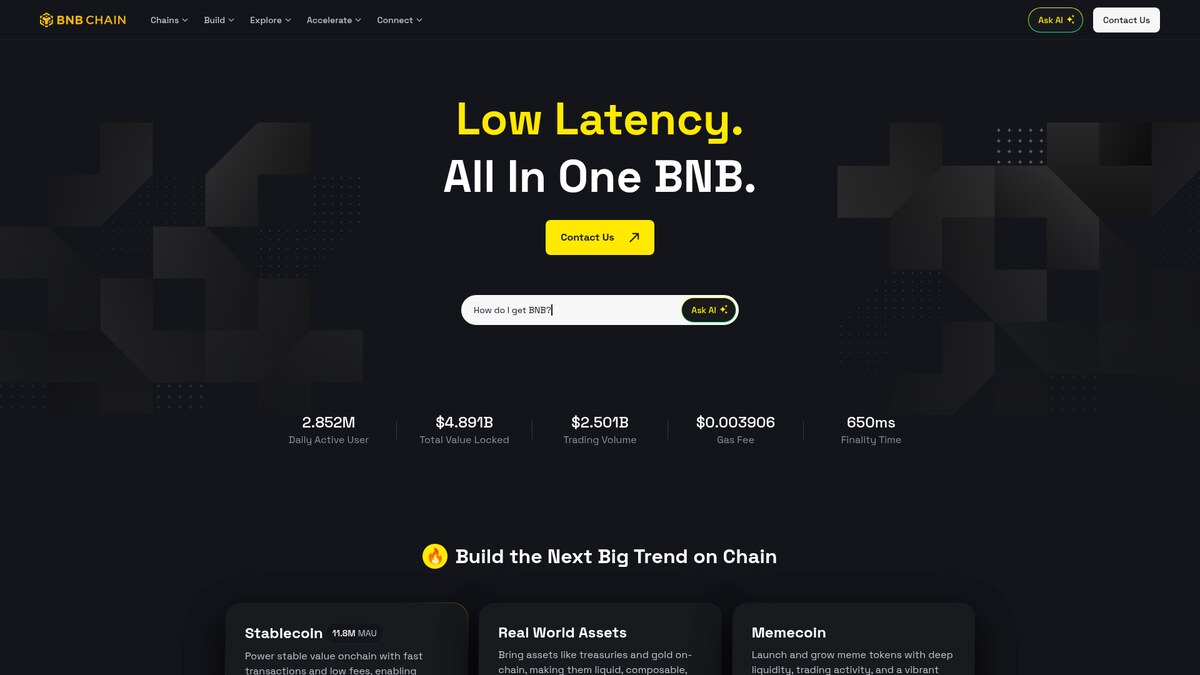
The Thesis
Reviewing BNB Chain requires setting aside the framework used for base-layer money and picking up a different one. This is not an attempt at a credibly neutral, unstoppable settlement network. It is a high-throughput, low-cost EVM environment operated in close alignment with the world's largest exchange, optimised for retail participation, and it has been extraordinarily successful at exactly that.
Scored against its actual purpose, the chain performs. Fees are consistently negligible, block times are fast, the EVM compatibility is complete enough that Ethereum tooling works unmodified, and the on-ramp from the exchange to the chain is the smoothest in the industry. For an enormous population of users — particularly outside North America and Western Europe — this is the chain where crypto is affordable enough to actually use.
Usage & Liquidity — 5.0
Daily active addresses and transaction counts place BNB Chain among the most heavily used networks in existence, and unlike several competitors that number is dominated by ordinary retail activity rather than by a handful of automated systems. Stablecoin liquidity is deep, decentralised exchange volume is substantial, and the launchpad culture around new tokens — for better and worse — generates continuous organic demand for block space.
The practical consequence is that a builder targeting emerging-market retail users can reach them here more cheaply and more directly than anywhere else. That is a genuine and underrated form of product-market fit, and our framework credits realised usage over theoretical elegance.
Technical Depth — 3.5
The architecture is deliberately unadventurous: a proof-of-staked-authority consensus with a small active validator set, tuned for speed and cheapness rather than for resilience against a hostile world. Recent upgrades have compressed block times further and improved finality, and the opBNB layer two plus the Greenfield storage network extend the stack sensibly.
But there is little here that advances the state of the art. The chain's technical decisions are downstream of Ethereum's research, implemented pragmatically with the safety margins tightened. That is a legitimate engineering choice for a performance-oriented network, and it is also why this line does not score higher.
The 2022 bridge exploit, in which an attacker forged proofs to mint an enormous quantity of BNB, remains the most important entry in the technical record. The response — halting the chain to contain the damage — was pragmatic and protected users, and it also demonstrated conclusively that the network can be stopped by coordinated action. Readers should file that as a permanent property, not a historical footnote.
Tokenomics — 4.0
BNB's monetary design is straightforward and has been executed consistently: scheduled burns plus a real-time fee burn have steadily reduced supply toward the stated target, and the burn programme has run on schedule for years. The token has genuine, multi-purpose utility — gas on the chain, fee discounts and product access in the exchange ecosystem, staking for validators — and demand is not manufactured by emissions.
The deduction is concentration of both holdings and destiny. BNB's value is tightly coupled to the commercial and regulatory fortunes of one corporate group. That coupling has been a tailwind for most of the asset's life; it is nonetheless a single point of failure that no amount of burning changes.
Decentralisation — 2.0
A small validator set with substantial overlap in affiliation, a demonstrated ability to halt the chain, and governance that in practice follows the direction of one organisation together produce our lowest sub-score in this review set. This is not a claim of bad behaviour — the chain has been operated competently and users have been protected during incidents. It is a description of where trust sits.
If your reason for using a blockchain is censorship resistance or credible neutrality, this chain does not deliver it and does not seriously claim to. If your reason is cheap, fast, well-connected transactions with excellent exchange integration, the trust assumptions may be perfectly acceptable to you. Our job is to make sure you are choosing them knowingly.
Ecosystem & What To Watch
The ecosystem's character is unapologetically retail. Decentralised exchanges, yield aggregators, prediction games, launchpads and a very large volume of speculative token issuance dominate on-chain activity. That produces genuine fee revenue and genuine liquidity, and it also produces a higher-than-average density of low-quality and outright fraudulent tokens, which is a real hazard for inexperienced users navigating the chain without help.
Institutionally the chain has quietly gained ground: payment processors settle on it, tokenised products have launched on it, and the Greenfield storage layer plus opBNB give enterprise builders a coherent stack. Whether those users stay depends less on technology than on the regulatory trajectory of the affiliated exchange group.
The specific things we watch are validator-set expansion, whether the chain-halt capability is ever exercised again, the pace of stablecoin issuer diversification, and how much of the retail activity survives when incentives cool. A chain this dependent on one distribution channel deserves continuous re-underwriting rather than a one-time verdict.
The Verdict
BNB Chain is one of the most useful pieces of infrastructure in crypto and one of the least decentralised. Both statements are true, and pretending otherwise in either direction would be dishonest reviewing. It has served hundreds of millions of transactions cheaply and reliably for users who had few affordable alternatives.
Three and a half out of five. Excellent utility, real economics, and trust assumptions closer to a well-run financial platform than to a public settlement network.